Showing posts with label September 11 Reflections. Show all posts

Friday, September 11, 2026

25 years later and it still seems like yesterday

25 years ago this morning I was excited to be away from home, a freshman at college for all of two weeks. I got up early to go for a run at the track near my dorm before class that morning, and when I came back into the building I noticed several people standing in the lobby watching what appeared to be a disaster movie on the TV. This struck me as an odd choice early on a Tuesday morning and I went over to see what they were doing. It was this decision that meant that I was watching when the second plane hit the south tower, and was still watching when that tower collapsed less than an hour later. 

My life is pretty different now than it was on that Tuesday morning 25 years ago. The world and this country are pretty different too. For several years after 9/11/2001 I wrote a reflection, which I shared on the anniversary. You can find most of those here: September 11 Reflections

I haven't done that for a while. Other important things, things like life, work, and five children have taken priority. But it seemed especially appropriate to write something today. 

The country is heavily divided in 2026 and symbols that brought unity in 2001 and 2002 (such as the image to the right) don't carry the same weight as they did then. Broadly speaking, pride in America is lower than I have seen it in my lifetime. And yet, I have never been more proud of this country, and the flag that represents it. 

I have worked for the executive branch of the federal government for the last 17 years. A significant portion of that time was spent telling the stories of America in the places where those stories happened or at memorials built to commemorate key people and moments in this country. 

Memorials are important. There is power in a memorial that simply can't be captured elsewhere. We are living in a strange time for memorials. Many were torn down or defaced in the wake of the overdose death of George Floyd in 2020. Now we have a dichotomy of a president who can variously appear as being primarily concerned with memorializing himself, or as a great champion of commemorating American stories and exceptionalism. We should all be able to agree that fixing the reflecting pool in and restoring fountains and memorials in our nation's capitol should be a cause for celebration, but it hasn't been. Even as we reached the semiquincentennial of this nation's founding. 

While living in Washington DC I had the chance to visit each of the 9/11 memorials, and I am very glad I did. Alison and I actually visited ground zero in New York on the anniversary the first World Trade Center bombing in 1993. What you encounter at the site of the towers is inclusive, in that it memorializes, not only those who were killed at that site in 2001, but also those who perished in Washington DC, and Pennsylvania, as well as the victims of the 1993 bombing. Every day flowers are placed in the etched names of any victim who would have celebrated a birthday on that day. 

Today President Bill and Hillary Clinton, President George W. and Laura Bush. President Barack and Michelle Obama, and President Joe and Jill Biden joined Vice President J.D. Vance at Ground Zero along with former mayor Rudy Giuliani for a special ceremony that included surviving family members reading the names of those who were killed. It is a simple yet powerful memorial.


Ground Zero was not the first place affected by the attacks on 9/11 that I visited. Right across from Washington DC, the memorial at the Pentagon memorializes the 184 Americans who died there when American Flight 77 crashed into the Pentagon. Arranged according to age (ranging from 3 yrs to 71 yrs old), each bench of the memorial positioned to indicate those who were on the plane and those who were in the building. 


In 2015, we visited the location in a field in Shanksville, PA
 where United Flight 93 crashed into the ground. There is more there now then when we were there 11 years ago, but even then a wall of names told the story of the 40 passengers and crew aboard that flight, many of whom decided to force the plane to crash rather than let it reach its destination in DC. 


There is power in these memorials and the stories they tell need to be remembered. For my children these events are no different than learning about the American Revolution or the attack on Pearl Harbor. But they should be. These are stories we need to tell, which is why I did just that with the kids last night, to make sure they understood why the flags were at half staff today. It is incumbent upon we who lived through it to ensure what happened that day is remembered and always seems like yesterday.

Thursday, September 11, 2014

A Different Perspective: Seeing September 11 Through the Eyes of a Federal Law Enforcement Officer

This year, the anniversary of the terrorist attacks on September 11, 2001 carries a new and greater significance for me. This new meaning is derived from two developments that occurred in my life in the first half of 2014. The first was that Alison and I visited the 9/11 memorial in New York. I had heard much about the new memorial, but had not yet had the chance to see it in person. By chance we ended up there on February 26, the anniversary of the first World Trade Center Bombing in 1993.

It was an especially poignant time to visit, since the monument memorializes, not only those who were killed at that site in 2001, but also those who perished in Washington DC, and Pennsylvania, as well as the victims of
of the 1993 bombing. Every day flowers are placed in the etched names of any victim who would have celebrated a birthday on that day. On February 26, a special group or roses adorned the section of the memorial dedicated to the 1993 attack.


The memorial is beautifully designed, with water pouring down on all four sides of the footprints of both the north and south towers. The water then pools together in the bottom, before plummeting down anew, into the unknown, beyond the scope of our vision. It is a simple design, but a highly evocative one that allows for personal interaction and poignant reflection.


Each of the names are etched into the sides of the memorial such that light can shine through at night and flowers can be placed inside each name in the manner described above. Several of those names are not names at all, but rather a denotation of unborn children who perished in their mother's womb before ever being given the chance to see the world at all.


In a nation where so many people fight to deny the unborn any recognition of life, it was particularly impactful for me to see those innocents memorialized in this manner.

The memorial also includes a special section devoted to the first responders who perished in their attempts to secure the scene and save the lives of anyone they could.

It is this section of the memorial that grips me the most as I sit down to write today. My perspective of the role of first responders has changed significantly as a result of the other new development I experienced this spring: being offered and accepting a permanent position helping to Protect and Interpret American History in our nation's capital.

I have spent the last four months in training learning what it means to be devoted to protecting the core of the United States of America. At its heart, the job is about safeguarding an idea, the idea that this nation is something special in the scope of world history. For all its faults (and I believe there are many), this nation and the manner in which it was created is truly unique. And I, for one, believe that it represents something that is worth fighting to sustain.

This final picture is one of my favorites that I took when we were in New York. In it you see a tree, just west of the south tower and south of the north tower, which still lives today, despite both towers coming down directly around it. Behind this tree can be seen the new World Trade Center building, rising above the city of New York as a symbol that that idea cannot be so easily overcome. Life that hung on through the devastation foregrounds reconstruction of a nation that accommodates remembrance and honor for the fallen.

So today, the 13th anniversary of the the 9/11 attacks, remember all of those who lost their lives that day, but give particular attention to the firefighters and law enforcement officers who rushed into danger to save others without hesitation. For many of them it was the last action they ever took, and that is something that is worth remembering.    

Previous Reflections

Wednesday, September 11, 2013

Other Forces at Work in the World


Twelve years is a long time. It doesn't seem like it has been that long since the terrorist attacks in 2001, but the date suggests otherwise. 

I was reminded of how long it has really been a few weeks ago while watching the teen tournament on  Jeopardy. One of the questions was, "In October 2001 Congress passed this act to deter and punish terrorism."  In my mind it was an easy question as the answer could not be anything other than "The Patriot Act," so I was surprised when none of the three contestants got it right.  But then Alison pointed out that these kids would have been no older than 4 or 5 when the Patriot Act was passed. To them it is no more current than the Sedition Act of 1918 or the Social Security Act of 1935. Twelve years can, indeed, be a long time...

In some ways much has changed since that September morning twelve years ago, but in others very little has changed at all. 

My own thoughts have certainly developed as my focus has shifted and widened. Last year I reflected upon the ways in which my perspective had changed in May It Always Seem Like Yesterday. 

One thing that appears not to have changed is the manner in which politics influence and guide this nation. The surge of national unity that followed September 11 is difficult to find in our current political climate. Partisanship reigns supreme and many of the same problems remain or have gotten worse. It is easy to feel as though there is little reason to hope, and I have often felt that way myself. The failures and inaction of Congress and our president have had deep personal impacts on my life and it often appears as though our leaders care little for the effects their decisions and actions have on their constituents. Yet, as I write to you today, hope is the very thing that is on my heart. 

As bleak as things sometime appear, it is helpful to remember who we are and where we have come from. I am currently taking three classes in what will, Lord willing, be my last semester of coursework (with a research seminar and internship to follow in the spring) of graduate school. Those three classes cover the early American Republic, Reconstruction, and the interwar period (between WWI and WWII). As I find myself in the midst of my third week of class, I have already observed a multitude of connections between these three periods of American history. Of these connections, the most prevalent is that all three classes cover the period immediately following a time of war and great national upheaval. In fact, it could be argued that they cover the aftermath of the three most defining moments of conflict in this nation's history. 

In each case, the nation that emerged from the fire of war and ashes of loss was very different than the one that had existed beforehand. But also in each case, things did not go smoothly. The Alien and Sedition Acts under Adams' presidency and the infighting between Federalists and Jeffersonians nearly tore the new country apart in the 1790s. The violence, poverty, and oppression that developed in the South after the Civil War continues to leave ripples in our society today. The fear and uncertainty in this country after the Great War resulted in incredible violence, labor unrest, and general mistrust and backstabbing that rivals any other period in our history. These were not times of peace and prosperity for most people.

But these were also times of transformation. On the far side of the tumult the United State emerged as a "treaty-worthy" nation with equal standing to the major European Powers by the 1820s: as a newly united nation that passed legislation to, not only abolish slavery, but grant civil rights and suffrage to it former slaves by 1870: and as the preeminent world power that became a potent symbol of the positive force of democracy, especially when contrasted with the totalitarian regimes that would soon emerge. Although in each case, there were plenty of reasons to despair, there were also very good reasons to hope in these periods that most define our nation.

A few weeks ago Alison and I saw a performance of Shakespeare's play, "Much Ado About Nothing." It is a tale full of scheming, backbiting, and attempts to thwart others. But in the end, the truth prevails and all of the plotting and deception proves to be much ado about nothing. Perhaps, in the bigger picture, as hopeless as things may seem, even our current political culture will prove to be likewise.

It remains to be seen what role 9/11 and the wars waged in its aftermath will play in the legacy and future of the United States, but perhaps we have more reason to hope than it might often appear.


This past Saturday Alison and I had the pleasure of watching "The Fellowship of the Ring"with all of the music performed live at Wolf Trap National Park for the Performing Arts. It is a splendid way to watch the film. Although I have seen that movie at least 20 times, there is One Scene that grabs hold of me every time I see it. Saturday was no exception.

In the dark of Moria, when all hope seems lost, Frodo laments:
"I wish the ring had never come to me. I wish none of this had happened."

Gandalf's response reveals wisdom that transcends that particular moment:
"So do all who live to see such times. But that is not for them to decide. All we have to decide is what to do with the time that is given to us."

We cannot control our circumstances, but we can decide how we respond to the situations we face and what we do with the time that we have on this earth.

But Gandalf doesn't stop there. He continues by saying:
"There are other forces at work in this world, Frodo, besides the will of evil."

And concludes with the statement:
"Bilbo was meant to find the ring. In which case you also were meant to have it. And that is an encouraging thought."

That is, indeed, an encouraging thought. We don't have to look very hard to find the reality of evil in this world, and few events speak of its presence in this nation with more force than 9/11. But we do have reason to hope. There is more going on than the reign of evil. There are more powerful forces at work if we have the eyes to see them.

We don't know how much time we have or how and when we will die. But we do know that we have an opportunity each day to make this world a better place than we found it. And we do know that God is sovereign, and that even when we cannot see the way ahead, his power is still very much at work.

So on this twelfth anniversary of the tragedy of 9/11 take a long view of history and find hope in the thoughts that we can change the world we live in, that no matter what we face, we always have the chance to decide how we will respond, and most of all, that there are forces at work in this world more powerful than the will of evil.


Reflections from Previous Years

Tuesday, September 11, 2012

May it Always Seem like Yesterday


In a few days I will drive north to spend five full days in Harpers Ferry and Antietam to help document and commemorate the 150th anniversaries of these two Civil War battles.  Exactly one year ago I wrote about the commemoration of the Civil War and observed that “I retain hope that I will get to [work at the 150th anniversary commemoration] at one of the other battlefields in the next few years.” Now I am working at nearly all of the big anniversaries in a position that I certainly did not foresee when I wrote those words a year ago.   The path of life is often characterized by unexpected turns. Mine most certainly has been in recent years.

Today marks the eleventh anniversary of the terrorist attacks on the World Trade Center and the  Pentagon. For many people those attacks are little more than a distant memory. For some, they are a chapter in the history books. But for the families of those who lost their lives that day and the soldiers on the front lines in Afghanistan, the 9/11 attacks continue to resound with and reverberate with great force. Much changes depending on the position from whence we view something.  In looking back on what I wrote on 9/11 each of the last four years I have been struck by the differences in tone each year as my perspective has changed. Yet, through each perspective there are windows that reflect larger truths.

Seven Years of Reflections

Four years ago I wrote about the upcoming presidential election.  I wrote that, “This is an important season for our country. We will soon be facing one of the most significant presidential elections in American history. It is a big deal and our future will look very different depending on what happens in that election.”  I think that was a fair assessment four years ago. I also think that the current election climate could be described in a similar fashion.  I am continually disappointed at the divisive and derisive characteristics of each of the primary presidential candidates. Seeking to capitalize on division and fear is precisely what this nation does not need, and I, at least, find myself pushed further away from both candidates as a result.  

Again the words I wrote in 2008 seem appropriate: “as we think about who to vote for and listen to the rhetoric of both candidates, let’s think beyond simply our own personal needs and think about what we should do as citizens of God's kingdom.”  The words of the prayer with which Jena Lee Nardella closed the opening night of the 2012 Democratic Convention last week express a similar sentiment.  “Give us gratitude for our right to dissent and disagree. For we know that we are bound up in one another and have been given the tremendous opportunity to extend humanity and grace when others voice their deeply held convictions even when they differ from our own.”

It is so easy to get caught up in what makes us different. But 9/11 reminds us that we would do far better in these next eight weeks to focus on our common bond as Americans and, as I wrote four years ago, “be who God told us to be. Let’s live out of love and fill each day with the kind of selfless loving sacrifice that we saw exhibited on 9/11.” 

9/11 redefined what it looks like to be a hero. The heroes of 9/1 were Police officers, firemen, and ordinary citizens, who saw a need, took decisive and selfless action, and in far too many cases lost their lives.
Though our response to 9/11 is usually focused on the war on terror, in 2009 I attempted to remind us  “perhaps we would do better to rethink the meaning behind those actions, to recognize what we are doing wrong, and to let it be the progenitor of a new way of living.  If we are willing to take that journey we may well find, like John Muir did when he viewed the natural beauty that surrounded him that, “new beauty meets us at every step in all our wonderings.” And there is nothing more valuable than the pursuit of truth and beauty.”


It is difficult to look at pictures such as these and not see truth and beauty. It doesn’t matter if these men are Democrats or Republicans, white or black, straight or gay. Such images reflect the higher ideals that this nation represents.

It was such ideals and ideas that I wrote of in 2010. “Ideas are what this nation is founded upon. Ideas centered upon the unalienable axiomatic rights shared by all citizens of humanity… “There is nothing more important than the unity of the common bond of humanity, uniting us together as a free and independent state firmly relying upon God and his values as we seek to live them out in support of one another. That, like our fathers before us, “’with a firm reliance on the protection of divine providence, we mutually pledge to each other our lives, our fortunes, and our sacred honor.’”

Tragedies like 9/11 have a way of showing our true colors, of reflecting what we believe in vibrant color. Last year in reflecting upon some of the anniversaries that were commemorated in 2011 I wrote that, “each of these anniversaries marks something significant that has helped to shape the character of America and determine what we, as Americans, believe in.” There is more to the United States of America than political discord. This nation remains unique in world history as a shining example of the value of the common man, and we cannot let our light be overshadowed by the darker side of our national character. As President Bush put it: “we are the brightest beacon for freedom and opportunity in the world and no one will keep that light from shining.”

We do not always agree. We need not look far for proof of that. If there is one thing that my work with the sesquicentennial of the Civil War has consistently reminded me of, it is the importance of love and common purpose and the danger of divisiveness. We are defined by what we believe. Last year I wrote that: “Our beliefs shape us and determine the way we live. Let us believe in something worth the believing, in the loving compassion of a God that desires that all of his creation be reconciled unto Him so that each element might both bring glory to His name and live as it was intended to live, in an existence characterized by freedom, hope, community, and love. “  

Symbols are powerful agents for change. Let us use 9/11 as a continued symbol to unite this nation together and better reflect not only our national values, but the values of out Heavenly Father.


Last year on 9/11 I had to work at the Visitor Center in Shenandoah but Alison went to the Newseum in
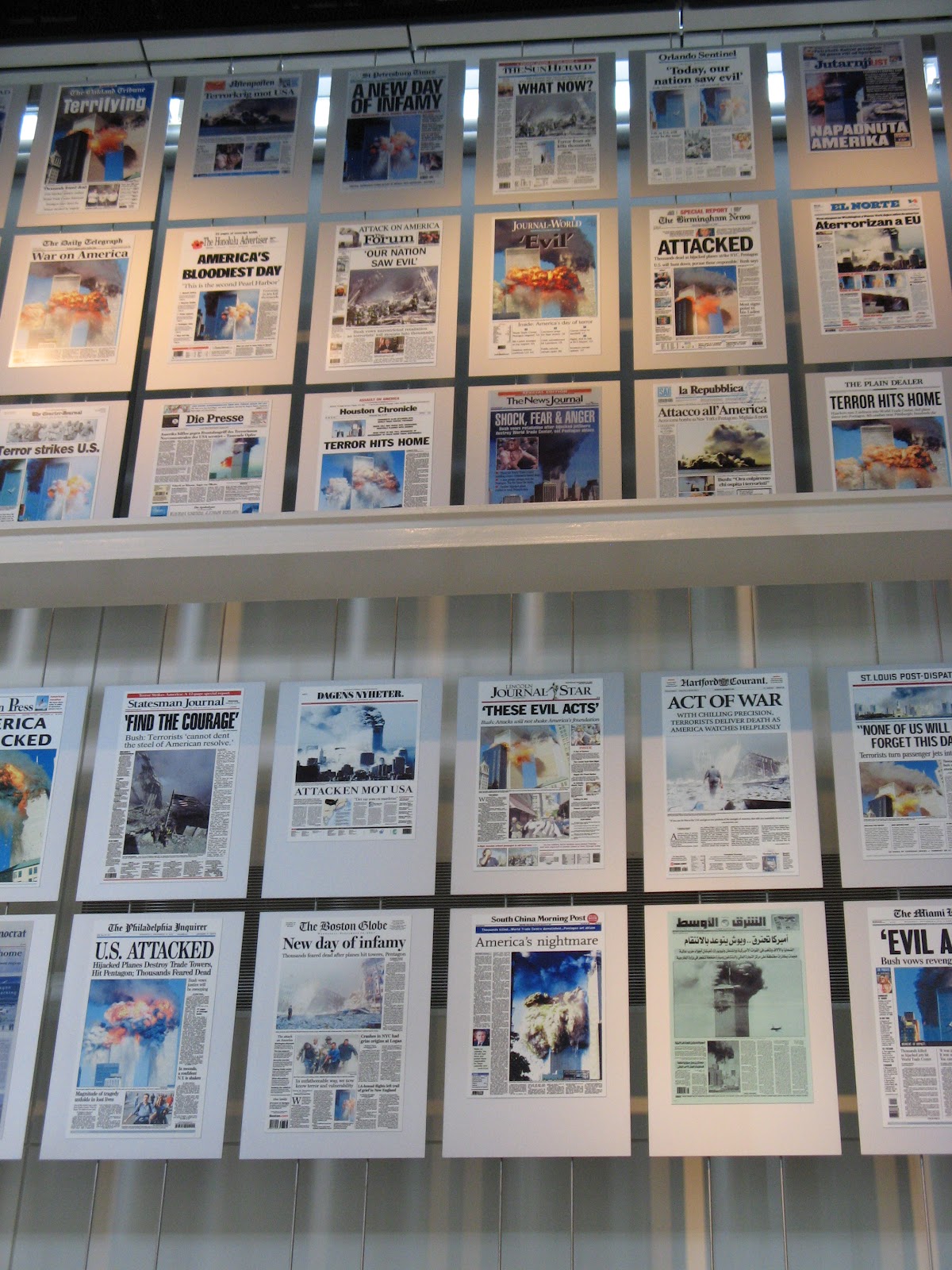
Washington, DC. In a city known (and rightly so) for the Smithsonian museums, this newer arrival is often overshadowed. But it bears powerful reminder of the importance of perspective and the impact of the unexpected turns in life. I got to visit it myself earlier this year. These are some of the symbols on display to help tell the story of America. 


   The radio antenna from atop one of the towers. 


 Display of the front pages of newspapers around the word proclaiming the attack.


May it always seem like yesterday.


Sunday, September 11, 2011

Determining the Course of Remembrance

Ten years ago this morning I awoke to go for an early morning run only a few weeks after beginning life as a college student in San Diego, CA. As I walked down the stairs into the front lobby I was surprised to find several guys in the common room watching what looked to be a disaster movie on tv, a strange occurrence that early in the morning. The oddity of the situation grabbed my attention and I paused to try and determine what they were watching. As I stood there I slowly began to realize that this was no movie; this was live footage from New York showing a flaming gash in the side of the World Trade Center. And then, even as I stood there watching, trying to take in the magnitude of what I was seeing, I was gripped by the image of a second plane striking the second tower. It is a moment I will never forget, an image forever burned into my memory.

There has been much talk and discussion as we have approached the 10 year anniversary of these events. There are many differing perspectives as we stand here now, with ten years of experience with which to judge the events of 9-11-01.  I am writing here this morning to set forth my own humble offering for general perusal.

Tragedies have a way of sticking with you far longer than most anything else in the fabric of human experience. Personal tragedies will often dramatically alter individuals for the rest of their lives. Corporate tragedies have the power to change nations. The attacks of September 11 have proved their power to do exactly that. The nation we live in today is dramatically different than the nation I woke up to ten years ago.

For many of you this is the ninth email that you have received from me on this date. My perspective and thoughts have ranged significantly over those years but the core spirit of reflection has remained the same. Something about this day inspires us to stop and think about what it is that we stand for and what it is that we believe. For what we believe is perhaps the most significant and important aspect of who we are, not only as individuals but as a nation. There is nothing that determines our actions so much as what we believe.

In his recently published book “Love Wins” emergent theologian Rob Bell writes that, “our beliefs shape us and guide us and determine our lives.” In these words Bell joins a chorus of others stretching across centuries of human thought and development who have advocated for the prominent role of belief in shaping the human experience.

There are many ways in which beliefs shape our lives. In September of 2001 many Americans believed that this nation was largely untouchable, that we were divinely destined to prosper and remain at the forefront of the world scene. Ten years later many are questioning those beliefs and considering what it is that both this nation and they as individuals stand for.

We are a nation living in fear of the unknown. That is no more evident than in the new governmental department created in the post 9-11 world, an entity with the sole purpose of protecting the essence of what it means to be American. I refer of course to the department of Homeland Security. One of the more recent innovations to come out of this department is the full body scanner, now conveniently available at an airport near you. To stand in one of those scanners made me feel quite a few distinctive emotions. A sense of deep and abiding security and trust in the safety being provided was not amongst them.

Today we mark the ten year anniversary of the attacks that changed America in the midst of a time of significant recession even as our current president is proposing his plan to pull this country back to a place of great prominence, success, and even envy in the eyes of the rest of the world.  As I listened to the speech he delivered to congress Thursday night I was impressed by the similarity of much of his language to that of his immediate predecessor in the aftermath of the attacks.

Amongst the many statements made by President Bush were the following…

“Terrorist attacks can shake the foundations of our biggest buildings but they cannot touch the foundation of America. These acts shattered steel but they cannot dent the steel of American resolve.”

“America was targeted for attack because we are the brightest beacon for freedom and opportunity in the world and no one will keep that light from shining.”

These were inspiring words. Whatever your opinion of President Bush or President Obama, it is difficult to not appreciate the power of their words. Both have the ability to unify the nation around a principle, especially those principles upon which this nation was founded.

And these principles are worth uniting around. There is little of more value than the ideas of freedom, liberty, equality, and opportunity that were so much a part of the rhetoric of our founding fathers. I believe it is to these principles that both Presidents have so often referenced and even paid homage to. And it is belief in these principles that lies at the very foundation of what this nation is meant to be.

This year marks a notable anniversary for September 11. Ten years is oft recognized as a significant milestone and much is being done to commemorate reaching it. One such event is the dedication ceremony at the newly completed memorial for flight 93 in Shanksville, PA. Alison and I nearly got to visit this memorial earlier this summer, but were sadly unable to stop. I have yet to see it, but when I do it will complete the triad of 9/11 sites (along with ground zero at the WTC and the Pentagon in Virginia) that symbolize the tragic events of that day.

Though I have not walked on the ground where United Flight 93 met its fateful end, I have walked on much other sacred ground in this past year and have come to realize that September 11, 2001 is not the only date marked by a significant anniversary this year.

The world “Anniversary” is one that we often use to commemorate all manner of things from
birthdays and weddings to deaths and national tragedies. Simply defined the word refers to the commemoration and/or celebration of a past event that occurred on the same day of the year as the initial event.  First officially applied to commemorate saints during feasts in the Catholic Church, this concept is one that has been commonly applied in recognition of significant historical events that have helped to formulate and define the fabric of our national identity here in the United States of America. The year 2011 marks a significant anniversary of several such events.

This particular day marks the Decennial (10 year) of the September 11 terrorist attacks, but that is far from the only defining and influential moment or development in the history of the United States being commemorated this year. Among the other especially notable anniversaries celebrated in 2011 are the following… 

This year marks the Semicentennial (50 year) of the establishment of the Peace Corps by President John F. Kennedy, an organization created with a threefold mission to, 1. Help the people of interested countries in meeting their need for trained personnel in particular fields, 2. Help promote a better understanding of Americans on the part of the peoples served, and finally, 3. Help promote a better understanding of other peoples on the part of Americans.  The people served by American volunteers in participating areas often have a dramatically different opinion of Americans than many others who live outside of this nation.

2011 also marks the Dodranscentennial (75 year) of Shenandoah National Park, where I currently reside. Shenandoah was founded in order to provide easy access to a protected wilderness area for the millions of Americans living in the mid-Atlantic region. It provides both recreational opportunities (I have personally hiked more than 250 miles in the park this year) and a venue for re-creation, in which the spirit can be renewed, rejuvenated, and reborn. 

Often overlooked in our history is the Battle of Tippecanoe, the battle in which Indiana Territorial Governor William Henry Harrison successfully defeated the confederation of American Indians led by Chief Tecumseh in 1811. Marking its Bicentennial (200 year) this year the Battle of Tippecanoe was in many ways the final straw for an American people who had grown increasingly perturbed with Great Britain in the years following the Revolution. When it was revealed that British officers had supplied Tecumseh and his men with firearms and munitions, the already volatile public opinion quickly blamed the uprising of Tecumseh’s forces upon British interference. This battle served as a significant catalyst leading to the American declaration of war against Britain only six months later.
But perhaps the most significant of all the anniversaries being celebrated this year is the  Sesquicentennial (150 year) of the American Civil War, arguably this nation’s single most defining experience. You don’t have to know me long to know that I am a huge nerd when it comes to the Civil War. So it has been of great interest to me to follow the various commemorative events centered upon the 150th anniversary of each battle and campaign. I nearly got to work as a ranger at the 150th anniversary of Manassas this summer but alas, things did not work out. I retain hope that I will get to do so at one of the other battlefields in the next few years.

Each of these anniversaries marks something significant that has helped to shape the character of America and determine what we, as Americans believe in, 9/11 no less than the others. So as we remember those who lost their lives ten years ago this day we would do well to remember what this nation stands for, the ideals it is founded upon, and what it is intended to represent. We would likewise do well to take a moment to go beyond our national identity and reflect upon our own beliefs about this world we live in and the role that God is calling each of us to play. Our beliefs shape us and determine the way we live. Let us believe in something worth the believing, in the loving compassion of a God that desires that all of his creation be reconciled unto Him so that each element might both bring glory to His name and live as it was intended to live, in an existence characterized by freedom, hope, community, and love.  

Saturday, September 11, 2010

With a Firm Reliance on the Protection of Divine Providence

This is the ninth time I have sat down to write a message on the anniversary of the events of September 11, 2001. A lot has changed in the last nine years. Much has changed on an international level, much has changed in this nation, and much has changed in my own life. In many ways each of these elements are distinct, but in some, they are intimately intertwined. As I reflect on my own journey over the last nine years I am reminded of my role in the larger picture, the larger story, the story of America, the story of planet earth, and the story of God. 

When I first sat down to write this email I was a sophomore at Point Loma Nazarene University in San Diego. I was seeking to find and establish my own identity in the midst of a nation searching to redefine its own. I write here today from a computer in the basement of the Jefferson Memorial, writing from an American icon in the heart of our nation’s capitol as a National Park Ranger, charged with interpreting and giving meaning to the American identity.

My perspective has certainly changed in these last nine years. It has greatly changed in the last year alone. A year ago I wrote this email sitting in the back of my truck in the shadow of Chimney Rock in Nebraska before spending the remainder of the day following the steps of the pioneers on the Oregon Trail. It is a fitting symbol for my own journey across the country that has brought me to the heart of the United States of America with the charge of bringing meaning to the same.

Much has changed in this city and this country since 9-11. In many ways we now live in a different world. The significance of what has changed since September 11, 2001 is very evident in my daily life here in Washington in a myriad of ways. Every time I walk up to the Washington Monument I have to take a circular path alongside walls built to keep vehicles from approaching the Monument and pass through security before actually entering the Monument itself. Much about the approach to the Capitol, the White House, and many other Federal buildings has been changed as well. It is strange to think that a single event can have such a dramatic effect on a national identity.

There is great power in an idea, and the idea that we, as a nation, are vulnerable to attack is a significant influence on our approach and policies to issues ranging from immigration to celebrating Independence Day. 

Ideas are what this nation is founded upon. Ideas centered upon the unalienable axiomatic rights shared by all citizens of humanity. This is not the first time that events that occurred in September  have influenced the course and identity of this nation. On September 11, 1777 the American army successfully stood its ground against the British at Brandywine. Although the British ultimately won the fight, the American defeat was a result of poor intelligence rather than poor fighting ability and it proved that we, as Americans, could and would stand up against the most powerful military force in the world. Eight days later, on September 19 Johnny Burgoyne launched the first of two attacks against Horatio Gates along the Hudson River that would culminate in the surrender of Burgoyne’s entire army on October 17, proving that we could not only stand up and fight, but that we could win.

Four years later Washington launched a coordinated attack against Cornwallis at Yorktown on September 28, leading to the surrender of Cornwallis three weeks later. That action effectively ended the military action of the Revolution, a sentiment which was made fact two years later on September 3, 1783 with the signing of the treaty of Paris. Four years after that the now united states came together and successfully produced the great compromise, a document we now know as the United States Constitution, officially ratified on September 17, 1787.

At this point you may be asking why I am telling you all of this. What does the American Revolution have to do with September 11th anyway? Everything. It has everything to do with it. Writing in June of 1776 John Adams stated that,
           "Objects  of the most stupendous magnitude, measures in which the lives and liberties of millions, born and unborn are most           essentially interested, are now before us. We are in the very midst of revolution, the most complete, unexpected, and remarkable of any in the history of the world.” 

It is this revolution that has come to characterize and bring definition to the identity of this nation. It is the unity that came out of this revolution that was so intimately touched by the events of nine years past. It is this revolution that causes us to believe that an attack upon one of us is an attack upon all of us. It is this revolution that gives meaning to the symbols of America across this nation.

I have been immersed in American History for the last eight months, not only reading a great deal, but also being privileged to see much of it first hand. Among the many things I have seen include both the Pentagon and Ground Zero in Lower Manhattan. It isn’t just a distant picture in my mind any longer; it is something tangible, that I have seen right in front of me. But I think the greatest and most lasting significance is not to be found in the physical locations of the attacks or in the details of the events that took place nine years ago, but rather in the impact that these events have had upon the American psyche.

Yesterday as I stood at the top of the Washington Monument directing people as they exited the elevator I noticed that five of the men that were exiting were dressed in the attire of a firefighter. I looked closer and saw that the patches on their arms bore the letters FDNY. I had the opportunity to talk to two of these men and asked them what brought them to DC. I was expecting the answer to be something about 9-11. Instead I was surprised to hear that they had come for a softball tournament that just happened to be this weekend. They went on to tell me that, though could not be in New York, they had gone to visit the Wounded Warriors at Walter Reed Medical Center the day before and would be at the Pentagon today.

Both of the men I was talking to had gone into the WTC towers that day. Both had risked their lives to save others. The one guy was stationed at a firehouse in Lower Manhattan in the immediate vicinity and was among the first to respond. He was the only one of the members of his engine company that walked away from ground zero that day. That was a deeply sobering thought. Here was a man standing in front of me for whom the events of 9-11 will be forever associated with sacrifice and loss, not only for the nation as a whole, but in the midst of his own brothers.

This is not a distant chapter in our history books. It is a deeply personal and life changing tragedy for many Americans. So let us remember those who lost their lives nine years ago. But let us also remember that it is but one chapter in a larger story, a story of a people united together in common purpose, through great adversity, in the sight of God.  

As George Washington put it,
           No People can be bound to acknowledge and adore the invisible hand, which conducts the Affairs of men more than the People of the United States. Every step, by which they have advanced to the character of an independent nation, seems to have been distinguished by some token of providential agency.

There is a higher purpose in the values upon which this nation is founded. I don’t mean to say that Americans are God’s chosen people. Rather that as representatives of these values we have an obligation to both hold true to them and to bring them into tangible application. There is nothing more important that the unity of the common bond of humanity, uniting us together as a free and independent state firmly relying upon God and his values as we seek to live them out in support of one another. That, like our fathers before us, “with a firm reliance on the protection of divine providence, we mutually pledge to each other our lives, our fortunes, and our sacred honor.”